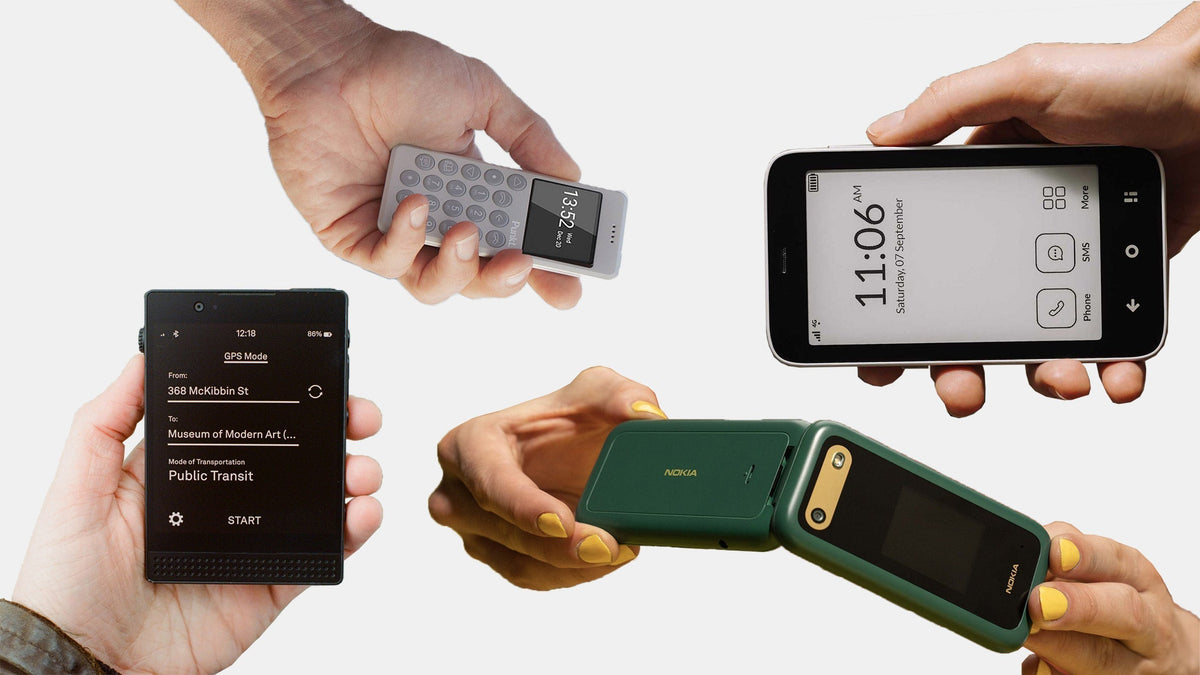
In a world of infinite scrolling and nonstop notifications, a quiet rebellion is gaining momentum. Some call it digital minimalism, some call it a detox, we'd call it a recalibration - either way, a growing number of people are voluntarily downgrading their phones, not because they have to, but because they want to.
It isn't nostalgia, or at least not only that. The average person now spends close to seven hours a day online (DataReportal, 2023) - that's not convenience, that's a second job. And it's pushed people back toward devices that do less on purpose.
A short history, on fast forward
Before smartphones, all we had were phones - and they worked. The Nokia 3310, the Motorola Razr: call, text, maybe a game of Snake, and that was more than enough. Then the iPhone launched in 2007 and within a few years a phone became the thing that held your work, your identity, your attention, all at once.
By the late 2010s, people started opting out. The New York Times' "Luddite Club" piece captured a real strain of youth rebellion against always-on tech and social media - kids trading iPhones for flip phones and, notably, choosing it. Not a hand-me-down, a decision.
Why now
A few things are converging at once:
Digital overload. Feeds, pings, an app for everything - the attention economy is working exactly as designed, which is the problem.
Mental health. Research has linked heavy smartphone use to anxiety, disrupted sleep, and attention fragmentation - a 2009 Stanford study found heavy media multitaskers were measurably worse at ignoring distraction and switching tasks, and later work in Computers in Human Behavior tied social media use to comparison-driven feelings of inadequacy. Worth noting: correlation, not a verdict on any one person's phone use - but the pattern is consistent enough to take seriously.
Privacy. As Punkt. puts it, a lot of this is about wanting a personal device that isn't constantly tracking and harvesting your data - not a rejection of tech, but a demand for a say in how it treats you.
Presence. The simplest reason might be the realest one: people want off-time. Less pull toward the feed, more room for an actual conversation.
And this isn't a fringe habit anymore. Reuters reported UK feature phone sales hit 450,000 units in 2024, with Western Europe feature phone sales up 4% year over year to 215 million units. CNN's own reporting on the category notes these aren't the throwaway flip phones of a decade ago either - premium dumbphones now run $229–299 (Punkt) up to $699 (Light Phone III). This is a considered purchase, not a downgrade.
Two takes on the same idea - both live at tm:rw
Punkt. MP02 strips a phone down to the essentials: calls, texts, Signal-compatible encrypted messaging, a Wi-Fi hotspot - no camera, no app store, nothing to check. Designed with Jasper Morrison, Punkt. describes it less as a detox tool and more as a way of giving people back a choice in how they engage with their own tech - some use it as a full replacement, others as what Punkt. calls a companion device: a phone that only holds the numbers of the people who actually matter.
Mudita Kompakt takes the opposite route to the same place. Instead of a smaller version of a smartphone screen, it swaps in an E Ink display that reads like paper - no glare, no blue light at 11pm. Offline maps, an e-reader, a meditation app, and a hardware switch that kills the mic and signal outright, no software workaround required.
Neither is trying to replace your phone outright. They're for the hours you want back.
Come hold both at tm:rw, Times Square - see which kind of "less" actually fits your day.

Leave a comment
This site is protected by hCaptcha and the hCaptcha Privacy Policy and Terms of Service apply.